AUTONOMOUS QA
TEST GENERATOR.
The Overview
Autonomous QA Test Suite Generator is an enterprise-grade engineering pipeline built in n8n. The system completely automates the manual, time-consuming process of digesting requirement documents, parsing agile board tasks, mapping functional scopes, and generating structured test matrices.
By integrating a real-time, closed-loop Human-in-the-Loop (HITL) rework engine, the automation moves past simple drafting: it monitors reviewer comments directly in Google Sheets and executes targeted, regression-free re-runs to refine test cases on the fly.
| Metric | Before (Manual) | After (Automated) | Change / Gain |
|---|---|---|---|
| Preparation Time | 4 to 8 Hours (Per Feature) | < 3 Minutes | -99% Time Saved |
| Test Case Coverage | Inconsistent / Subjective | 100% Systematic Coverage | Zero Scenarios Missed |
| Process Overhead | Docs review + sheet formatting | Single Form Submission | Frictionless Triggering |
| Rework Feedback | Manual rewrites / back-and-forth | Review-driven regeneration | Closed-loop Auto-updates |
| Sprint Velocity | Days of alignment delays | Instant test matrix syncing | Accelerated Cycles |
The Challenge
Engineering sprints are often throttled by slow quality-assurance cycles. QA engineers must manually parse complex Product Requirement Documents (PRDs), cross-reference user stories with active task boards, write step-by-step test instructions, and define exact expected outcomes. This repetitive, manual scope-mapping is highly vulnerable to human oversight, resulting in critical misses regarding boundary cases, payment limits, role permissions, and negative validation rules.
The Solution
I engineered a dual-pipeline automation engine in n8n that digests raw product specs or multi-file project sheets, maps relational agile boards to parent stories, and utilizes advanced LLM architectures to construct comprehensive, ready-to-test suites.
To guarantee absolute quality, the engine monitors the output spreadsheet. When a manual reviewer marks a scenario as rejected and leaves a comment, the system intercepts the update, runs a targeted regeneration AI node preserving other static fields, and replaces the specific row on the fly.
Workflow Architecture
The architecture is split into five distinct functional stages, managing raw ingestion, custom document pipelines, and interactive feedback loops:
- 1. Ingestion Routing NodeTriggered by a Google Form webhook collecting project metadata, modules, and target documents. A custom JavaScript routing node inspects file extensions and payload patterns to steer execution down the dedicated Document Path (Pipeline A) or Agile Board Path (Pipeline B).
- 2. Pipeline A: PRD Document ParserRetrieves PDFs or Word docs from Google Drive, running automated extraction nodes to strip clean body text. An LLM agent acts as a Technical QA Architect, formatting the text into a clean JSON structure separating functional rules, constraints, and edge-cases before splitting them into token-safe batches of three.
- 3. Pipeline B: Multi-File Board AggregatorProcesses relational sheets (Stories, Sprints, Epics). A pre-processing JavaScript script maps tasks to parent stories, cleans malformed rows, and generates balanced pairs of high-risk negative test cases (covering validation bounds, authentication limits, and data injection traps) alongside standard happy-path scenarios.
- 4. Pipeline C: Closed-Loop HITL Feedback ReworkA file-watcher watches target Google Drive folders. If a reviewer flags a test row as Pending and leaves notes in the comments, the system extracts the specific row data, feeds it to a targeted rewrite agent with full historical context, updates only the flagged steps, resets the state, and alerts the team.
- 5. Injection Layer & DeliveryJavaScript arrays normalize the LLM output, assign unique TestCase IDs (TC-MODULE-001), compute row tracking numbers, map fields to master column configurations, and copy-write the data. The engine immediately emails the QA Engineer a rich-HTML report containing direct access links.
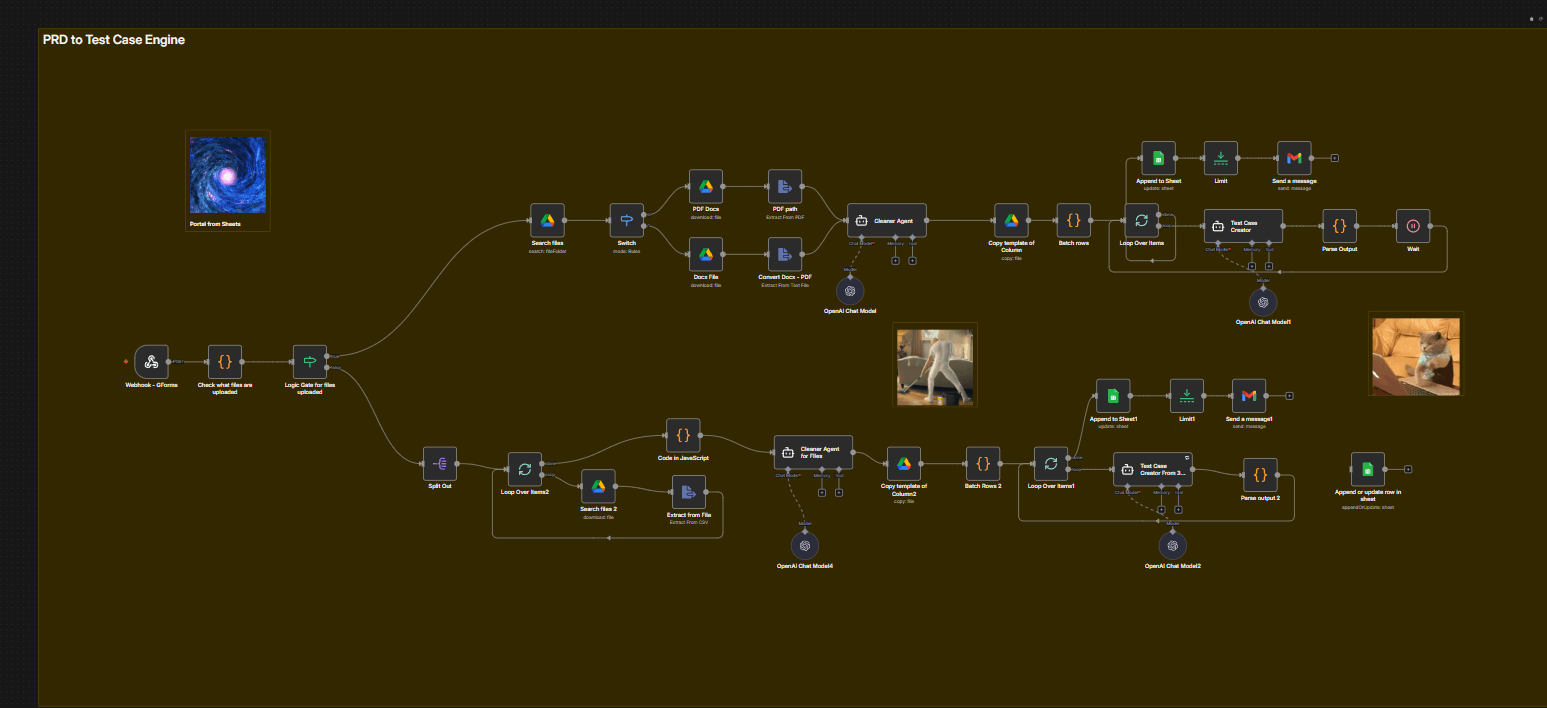
n8n Visual Canvas — Multi-branched conditional loops, agile board mapping logic, and feedback watchers
Portfolio Takeaway
This project proves how raw AI capabilities are exponentially improved when structured data pipelines and strict preprocessing boundaries are enforced. By isolating LLM operations into token-safe batches and establishing human-in-the-loop triggers directly inside standard spreadsheets, the system offers a collaborative workspace where engineers and AI align in real-time.
Tech Stack
- n8n (Workflow Orchestration)
- OpenAI GPT-4o & GPT-4o-mini
- Google Workspace REST APIs
- JavaScript (Relational Sheet Mapping)
- LangChain QA Prompt Architectures
- RegEx Payload Parsers
Key Features
- Dual Ingestion Inbound Routing
- Token-Safe Array Batching
- Relational Agile Story Mapping
- Closed-Loop Spreadsheet Watcher
- Targeted Specific Row Updates
- Rich-HTML Gmail Status Alerts